
Broadway Subway Station Houses Rise: 18 Months to Opening, But the Real Estate Play Is Already Here
Share
News article poster
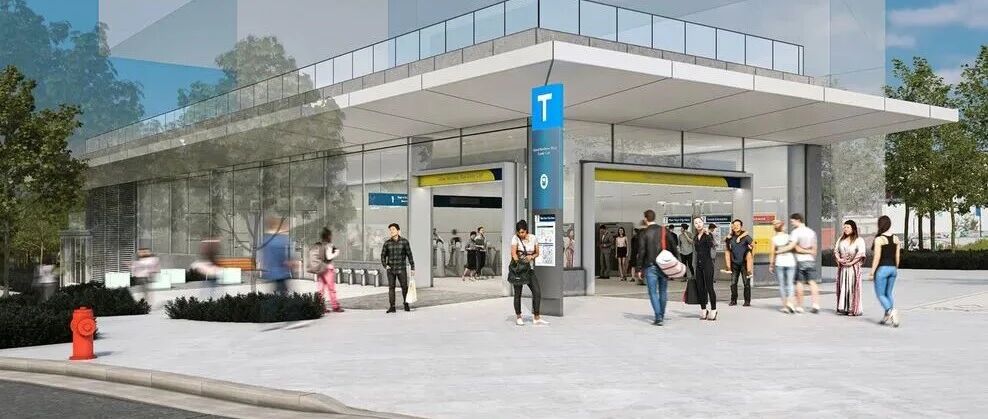
Construction crews have hoisted massive wooden ceiling panels—weighing up to 1,400 kilograms each at Oak-VGH Station—onto the steel frameworks of Vancouver’s Broadway Subway stations, giving the public its first concrete look at the Millennium Line extension’s above-ground architecture. Four of the six new stations will feature these distinctive timber ceilings alongside all-glass facades designed to maximize natural light and meet CPTED security principles. With 100 percent of the running rails now laid across the 6-kilometre corridor and a Mark I SkyTrain already conducting initial dynamic tests on completed western track segments, the project has decisively shifted from underground excavation to visible vertical construction. TransLink and the province remain committed to a late fall 2027 opening for the Arbutus extension.

The station designs vary significantly by location, signaling different real estate strategies for each neighborhood. At South Granville, the station is fully integrated into the base of PCI Developments’ 39-storey “The Stories” tower, which opens its 22,000-square-foot Loblaws City Market on June 26, 2026, creating an immediate transit-retail-residential nexus. Conversely, Great Northern Way-Emily Carr Station employs a concrete roof rather than timber, specifically engineered to accommodate future high-density mixed-use development by PCI adjacent to the site. Broadway-City Hall will become a four-level interchange connecting to the Canada Line, where platforms are being extended from 40 to 50 metres. Crucially, all station houses were designed with structural capacity for future vertical development above the entrances.

Rio J. Zhang Commentary
From a senior Greater Vancouver agent’s perspective, the Broadway Subway has crossed the threshold from “political promise” to “physical reality,” which changes how we advise clients. The visible station structures and active train testing remove the infrastructure risk that previously made pre-construction near the corridor speculative. However, the 2027 opening timeline coincides with potential interest rate volatility and significant new supply from projects like The Stories, so appreciation may be more gradual than the Cambie Corridor saw a decade ago. Buyers should focus on walk-score fundamentals—proximity to the grocery-anchored South Granville hub or the Emily Carr arts district—rather than betting purely on transit proximity. Sellers in Mount Pleasant should list before the Cambie Street closure creates summer access complaints.