
July Sales Drop 10%: Why Vancouver's Summer Bounce Just Fizzled
Share
News article poster

Home sales across Metro Vancouver stumbled in July 2026, with the Greater Vancouver REALTORS® (GVR) reporting 2,061 residential transactions on the MLS®—a 9.8% drop from July 2025's 2,286 sales and 18.6% below the 10-year seasonal average of 2,532. The decline erased June's fleeting 10% year-over-year gain, confirming what chief economist Andrew Lis characterized as the market's persistent "one step forward, one step back" rhythm. Apartment sales bore the brunt, plunging 17.8% to 952 units, while detached homes slipped 3.2% to 639 sales and attached homes edged down 1.1% to 454 transactions.

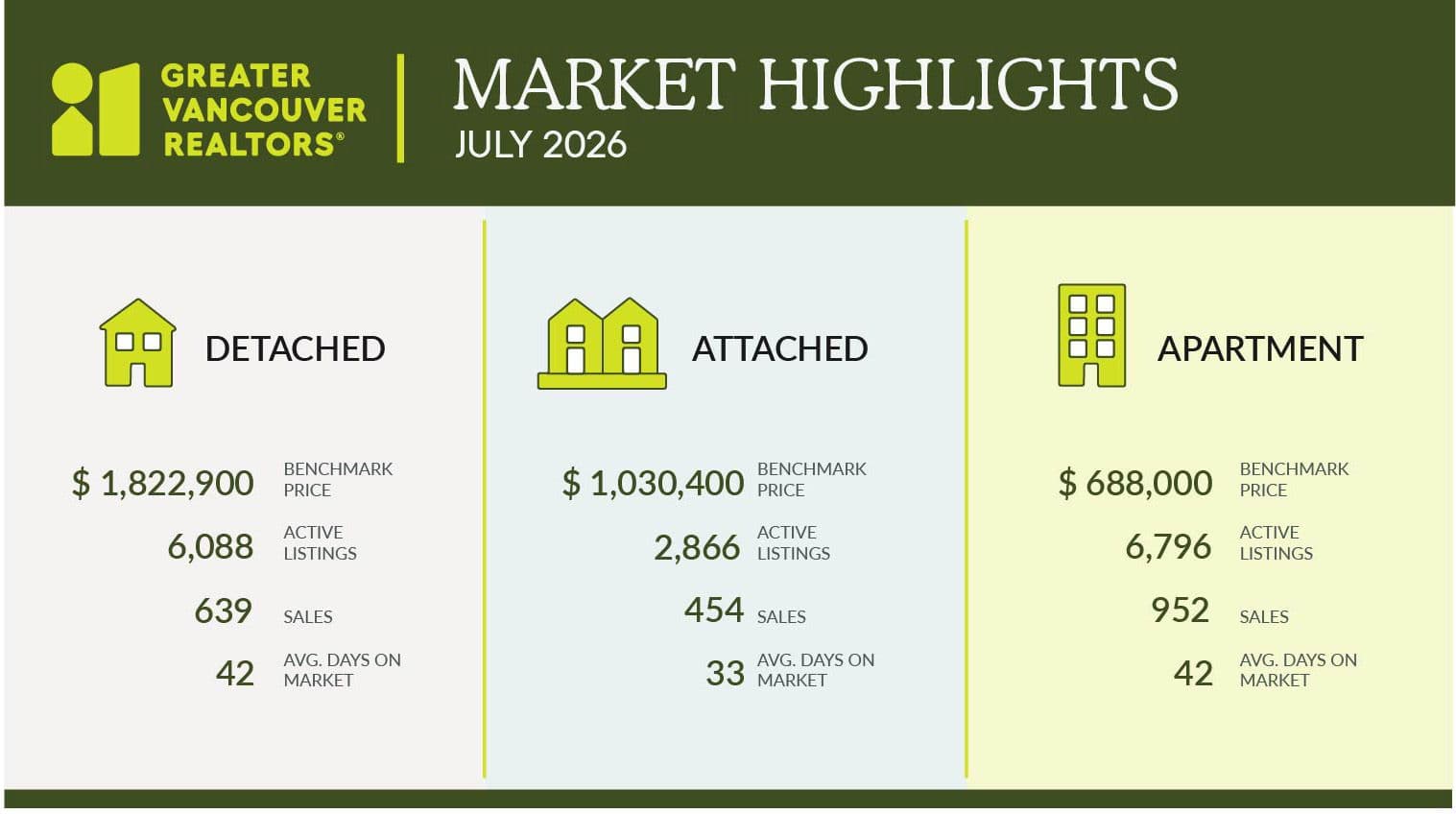
The sales-to-active listings ratio—a critical barometer of market pressure—registered 13% across all property types in July, with detached homes at 10.5%, attached at 15.8%, and apartments at 14%. Historical GVR data suggests sustained ratios below 12% typically exert downward price pressure, while readings above 20% tend to push prices higher. Current levels sit in this ambiguous middle zone, explaining why benchmark prices have drifted lower without dramatic correction. The composite MLS® Home Price Index stands at $1,088,800, down 6.2% from July 2025 and 0.9% from June 2026. Detached homes benchmark at $1,822,900 (down 7% year-over-year), apartments at $688,000 (down 7.5%), and townhouses at $1,030,400 (down 6%).

Kim Phung Thi Nguyen Commentary
From a senior Greater Vancouver agent's perspective, this data captures a market that's neither breaking down nor breaking out—it's simply exhausted. The June bounce was always suspect; it coincided with a brief rate optimism window that closed quickly. What stands out is the apartment segment's deterioration—down 18% in sales with listings following. That's where investor psychology is shifting, and it's worth watching whether rental demand softens in tandem. For clients, the practical read is this: buyers have time and selection, sellers need competitive positioning, and neither side should expect dramatic moves before the Bank of Canada provides clearer direction. The 13% sales-to-active ratio is the number to watch—if it holds below 12% through autumn, price pressure will build; if it recovers toward 17-18%, stability returns. Neither scenario suggests urgency for either side.