
BMO Vancouver Marathon Road Closures Set to Reshape Sunday Travel
Share
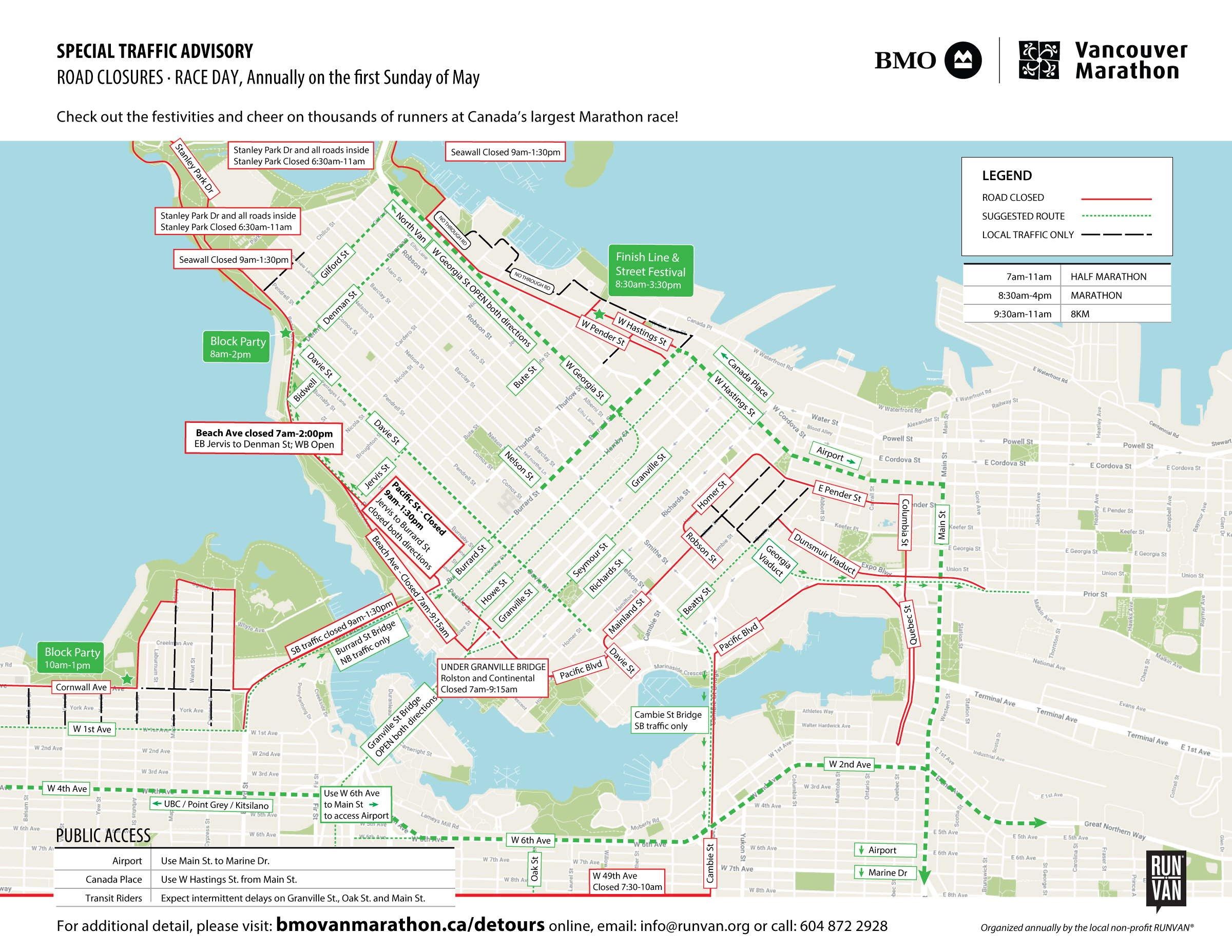
The 2026 BMO Vancouver Marathon is expected to reshape traffic across Vancouver on Sunday, May 3, as race routes move through Queen Elizabeth Park, South Cambie, Oakridge, Fairview, UBC, Point Grey, Kitsilano, the West End, Coal Harbour, Yaletown, Chinatown, False Creek and downtown. Organizers and local reports are warning residents to plan around rolling road closures, traffic control points and temporary access restrictions rather than assuming normal weekend movement.
The marathon weekend includes the full marathon, half marathon and 8 km race, with more than 25,000 registrations expected. The official detour notice says closures begin in selected areas on Saturday, May 2, and expand on race day, Sunday, May 3. Some roads will reopen as runners pass, but bridge access, waterfront routes and several residential pockets will be constrained during key morning and early-afternoon windows.
Question
Which parts of the city face the biggest practical disruption? The main risk is not one single closure, but the way multiple route segments overlap across downtown, False Creek, Kitsilano, Point Grey, UBC, South Cambie and Coal Harbour during the same Sunday morning travel window.

Editor's Comment
Marathon Sunday is one of those “micro-shocks” that can make Vancouver feel far less connected than it normally is—especially with overlapping segments spanning downtown, False Creek, Kits, Point Grey/UBC and key bridges. For real estate, the practical risk isn’t the home on the route; it’s missed showing windows, late buyers, and move-ins getting stuck on the wrong side of Burrard/Cambie or near Beach/Cornwall/Pender during the morning peak closures. If you must run appointments that day, group tours on one side of the course, send access/parking notes proactively, and build in a real buffer—20–60 minutes is realistic. Buyers should also treat race-day congestion as a reminder to check everyday access patterns (bridges, waterfront routes, event days), not as a reflection of a property’s typical livability.